This is not a review.
When Nagaraj Manjule’s caste-based atrocities film ‘Sairat’ was picked for a remake by Bollywood as ‘Dhadak’, that too by Karan Johar’s Dharma Productions, and with actors like Ishaan Khatter, and Jahnvi Kapoor, it quite predictably ignored the deeper cause that the film represented and took a safer, more palatable route of addressing the primary theme of lovers dealing with a class-issue as opposed to ‘caste-issue’. Frankly, I don’t see a problem with this, it’s a stupid decision to make, but stupid is easy consumption, and easy consumption is what sells.
But with Dhadak 2’s announcement, the idea was puzzling, this time, the producers had decided to adapt the brutal Mari Selvaraj’s Pariyerum Permual.
A film so rooted in its caste themes that it’s indistinguishable to turn into a mere ‘class’ film – what was even more puzzling was the casting of Siddhanth Chaturvedi, and Tripti Dimri – two faces that are far from the purview of films that fall into this category.
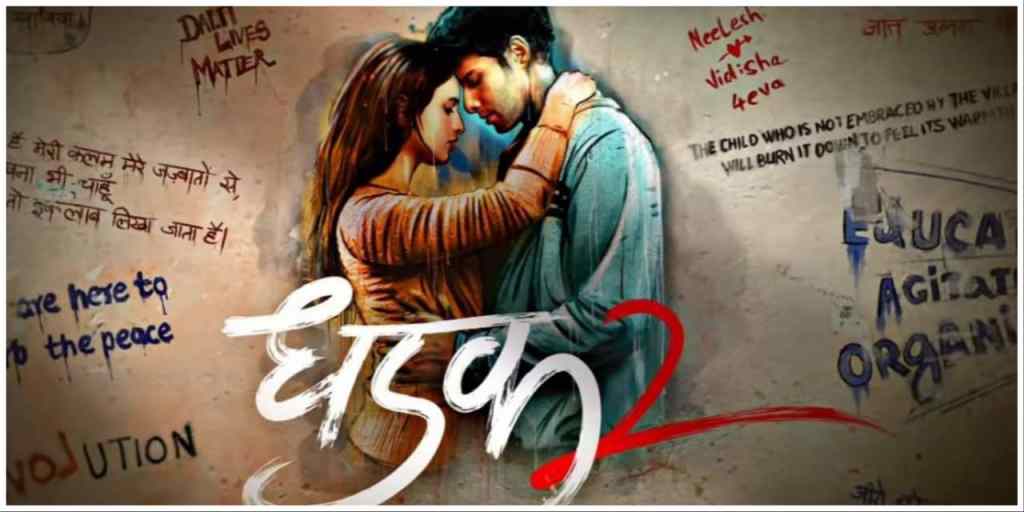
My interest for this film only piqued when I watched the trailer of the film and was quite intrigued by how much of the source material still seemed to be retained. With my expectations in check, I decided to watch this film purely to support the novelty of the effort to bring stories like to this forefront.
Now, there’s a certain uncomfortablness that creeps in, to watch Savarnas indulge in producing art that’s related to the experiences of the marginalized communities. The protagonist of this film, without a hint of subtelty is named Neelesh, who lives in an unnamed colony in Bhopal called Bhim Nagar, the first twenty minutes of the film has so much blue, and Ambdekarite references and imagery that you are almost left feeling worried and amazed that a Dharma Productions film even made this happen, and it managed to get released without too much censorship (although I am aware that the film went through 16 cuts) but there’s enough in this film to unsettle the status-quo – the film despite largely following the Bollywood visual language and tropes, yet manages to effectively, and unbashedly discuss what it wants to – head on. Take for example, a scene where a potential groom’s family visits Tripti’s house to discuss an alliance with her sister – the music that plays through this scene is comical, Tripti is a wise-cracking law student who plays a game of asking 5 questions to the groom’s family, and within these 5 questions the film also lays bare the two main themes that film explores – the agency of a woman, and the idea of caste and how it permeates the identities of our societies so deeply. It’s all done so comically, but you also get an idea of what to expect from the story.
Of course, people accustomed to the hard-hittingness and rawness of Tamil cinema will dismiss this levity, and scoff at the ‘Bollywood-ification’ of Pariyerum Perumal.
But what we need to really understand is that this is a Dharma Productions film, catering to a schmaltzy, cutesy love story loving crowd and has also defined Bollywoood since decades. To jump headfirst into giving its audience the same kind of rawness as Tamil cinema is abrupt, and off-putting.
Perhaps this mixing of ideas is depicted best when Neelesh is invited to an upper-caste wedding, and he has no clue what to dress like – he dresses as his favorite actor Shah Rukh Khan, and goes to the wedding where everyone’s dressed in kurtas, manyavars, suits…. Neelesh arrives wearing a brown leather jacket.
Those who’ve followed Bollywood, know how much of a large figure Shah Rukh Khan is – the undisputed ‘King of Romance’s films have come to define Bollywood as the place of dreamy love stories which have come to define our ideas of romance and love for decades and still continues to. So, when Neelesh decides to dress up as SRK and come, a Savarna perspective would be dismiss his style as ‘chapri’. But, with Neelesh dressed up as SRK, standing awkwardly in the wedding party of an upper-caste family, what we also see is the naive – cheesy, cookie-cutter Bollywood love story now entering the hard-hitting reality of ‘love’ in this country. A caste-divide, that mainstream Bollywood has shyed away from decades to show.
Thereby the debutant filmmaker Shazia Iqbal juggles the language of cutesy, Dharma Productions Bollywood storytelling, whilst also not holding back on the reality of the original.
This film even manages to sneak in a peppy dance number in the wedding sequence. And I was loving it.
Neelesh, who initially chooses to be apolitical is teased by an Ambedkarite, telling him his life has been political ever since he was born, the mere act of loving someone becomes a political act.
The rest of the film follows what happens when a naive, dreamy eyed Neelesh dares to enforce his identity as a Dalit man, and how reality continues to hit back at his masculinity.
With Dhadak 2, the makers have not only managed to attempt at juggling Bollywood storytelling with the rawness of the Tamil original, but have also ehanced the original by giving the love interest (Tripti) a stronger voice, and a character arc, unlike the original. We see Vidhi (Tripti) struggling to love Neelesh, as the people around him send him on an existential madness each day as he dares to question the status-quo around him.
Moreover the addition of an Ambedkarite leader character, Vidhi, Vidhi’s brother, all add a certain uniqueness to Dhadak 2 to manages to stand on its own despite the looming shadow of the original, these new additions lead up to newer directions in the second-half, which may or might not work for everyone in its execution, but works as a nice reminder that an ‘adaptation’ does not have to be a lazy remake of the original, but an ‘adaptation’ should add something new for the audience to take home.
And as much as lovers of the original might not like the idea of a Dharma Production-core Pariyerum Perumal, this is a bold, and appreciable step in the right direction.
With the sort of return-to-roots wave that’s going on now in Bollywood with potboilers with angry men gaining back attention again, and cheesy love stories (Saiyaara) making a comeback.
Bollywood is slowly getting back to bringing back its core audience and not desperate to become like European, or Hollywood cinema and failing at them.
During this return to roots wave going on – like it or not, the mainstream is dominated by Savarna storytellers, a film like this while still maybe unsatisfactory in representation, a Bollywood love story hit with the brutality of real life, produced by one of the iconic production houses of Bollywood, which is known to make dreamy love stories is an appreciable thing.
It’s hilarious to think that caste is a predominant factor in love and marriages in this country, yet the industry that has defined love stories has shyed away from addressing this theme head-on until Dhadak 2.
Please do go watch it if you have the time, and support such films.
I’d watch it again if I could.
Please go watch it before Coolie and War 2 eat up all the screens in the next few weeks.
 A notebook.