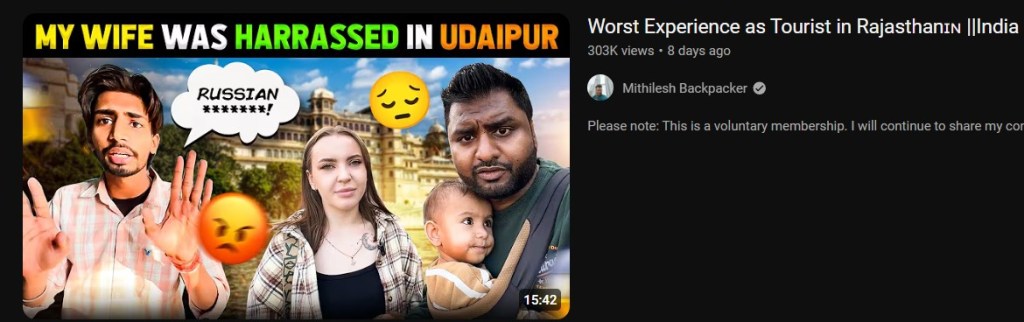
Recently, I came across a clip of an Indian vlogger who tried to confront a guy who made a passing “6000 Rupees” joke at his Russian wife. The comments section was filled with outrage, blaming a lack of education, unemployment, lower-income groups, and comedian Harsh Gujral (who popularized the joke unintentionally), along with the rise of ‘dark humor’ among teenagers online. This trend seems to have found newfound representation of their tastes in what is arguably India’s biggest show on YouTube—”India’s Got Latent.”
The format is fairly simple: a couple of contestants appear on stage and display their talents—it could be rap, poetry, singing, etc.—while the host, Samay Raina, and a couple of guests judge them and give points based on their assessments. While this is the underlying format of the show, the show’s USP is not the talents that appear on stage but the no-holds-barred approach to a reality talent show. It’s a major deviation and a big “fuck you” to the tailored, saccharine fakeness of the reality shows we see on television.

“India’s Got Latent” derives immense value from its charming host and the uncanny guests on the panel who change with every new episode —a mix of Internet celebrities and TV personalities like Deepak Kalal, Rakhi Sawant, Urfi Javed, Sid Warrier, Tanmay Bhatt, Raghu Ram, etc. Having this potpourri of personalities placed in a no-holds-barred comedy setting amidst the presence of the host is what drives the viewership. Samay Raina’s fanbase often touts him as a “Supreme Leader,” praising his fearless humor with phrases like “he didn’t hesitate” or “India is not ready for his humor.” I’ve followed his work since Comicstaan Season 2, which he won and then went on to smartly use his interest in chess to host entertaining live streams related to the game, his wit and talent for quick retorts, made him arguably India’s biggest comedian right now, at least among the Gen Z, and millennial audience who spend a considerable amount of time on social media.
I’ll admit I’ve only seen maybe one or two episodes of this show, and bits of it on reels—and that too out of FOMO. Watching this show feels like sitting with a group of friends who entertain themselves by roasting each other with sharp, sarcastic remarks. The way they take potshots at one another is where the entertainment is derived from.
The episodes that I’ve seen had the typical “Kashmiri stone-pelting jokes”, “African men must have a long penis” stereotypes, and the usual “Deepak Kalal is effeminate and horny” type of humor. It truly does feel like being in the middle of a friend group, where everyone roasts each other unapologetically. It’s an easy, breezy show one can watch without having to think too much about things—the equivalent of scrolling through your Instagram FYP with the occasional memes causing you to chuckle.
So, what’s the problem with this? There is no problem. It’s the same type of jokes you’d hear in a tight-knit friend group, now being elevated by a platform featuring professional comedians and celebrities who give it an air of credibility. The interesting thing is, these jokes of which the premises are usually built upon are existing stereotypes about cultures and its people which have been in existence since the era of boomers, it’s merely packaged differently now, in a more sophisticated way.
If you picture these comedians in their 40s or 50s, their humor doesn’t feel much different from the regressive remarks made by uncles and aunties. The key difference is that these comedians are self-aware and present their jokes in a language that resonates with Gen Z and millennials. So, in the end, you are only left feeling ‘wah, kya timing hain’—’wah kya counter diya hain’, ‘kya roast kiya hain’—but you are never really laughing in awe of what the joke is because you have already heard it in some form or the other.
Now, I firmly believe it’s stupid to censor jokes, and I don’t even agree that there should be a limit on the type of jokes one should or should not make. If there’s a willing audience for it, one should always be free to make that joke. ANY JOKE. But then again, this causes another discussion about the existence of an audience that pays to laugh at these kinds of jokes, and what does it tell about the general disposition about this audience.
However, I also do believe the artist must be sensible enough to understand the kind of audience the joke is being delivered to, and the audience must be sensible enough to understand the type of joke it is. This ideal balance between comedians and audiences rarely occurs in reality. And since the quality of the art is only as worthy as the audience deems it, the audience decides what stays relevant. The comedians will always blend and adjust according to their audience because that’s who they earn their daily bread from.
Neville Shah, who once made a joke about SC/ST reservations in medical examinations in his comedy special, now plays his part as an intellectual balance in the TISS podcasts, eschewing wisdom and wit among the banter that the podcasters/comedians share—these same comedians had previously written bits based on lazy stereotypes.
Tanmay Bhatt has happily moved on from the infamous #MeToo controversy of AIB, and is now minting money making meme reaction videos and eschews knowledge on his Youtube channel – this is the same guy who tweeted some odd intrusive thought masquerading as a joke, something about coming across naked baby pictures of women he knows of.
These guys will jump at the opportunity of appearing as a guest on India’s biggest comedy show on Youtube.
It is no surprise that the same boomer humor we’ve been hearing since ages, and cracked in schools is now being consumed as ‘dark’ humor—a term that’s been associated with a sense of exclusivity to it, a mettle to handle these proves an upmanship in your social capital among the friends group. So now, the same racist, sexist, or whatever -ist people among your circle have found a name to their behavior, which is ‘dark humor.’
Silencing a comic artist is an infringement on their freedom of speech. AIB has been an early victim of this, with their AIB roast. Comedians have long known to be pushing the boundaries with their edginess, but one can’t help but wonder, is that all that there’s to these comedians? Why is it that only the edgelords garner the most attention? Why is a dismissal of such jokes prompting such a polarizing reaction to that point that it almost becomes a badge of accomplishment? This inevitably becomes a competition of who has said the edgiest thing and gotten the most backlash.
A few months ago, some female participant on the show had made a joke about Bengalis protesting, given the recent RG Kar case. Understandably, not a lot of people were kind to this, especially considering it’s a woman making such a joke. And that led to some backlash among people—this led to two divided opinions—why can’t people take a joke? and why are people making such a joke in the first place? Some of those who defended her commended her for her audacity to make such an edgy joke. Those who were criticizing her shamed her for her insensitivity towards the current climate.
While a more productive question would’ve been, is such a joke even remotely funny in the first place? Does this deserve any bit of attention, really? Bengalis being woke and protesting has been a stereotype since decades ago—how is it even a joke? It’s merely a stereotype.
Similarly, a few more months before that – a Telugu Youtuber got cancelled, and arrested for making some joke about an innocent video of a father and his little daughter.
Celebrities, and many netizen jumped on the bandwagon of criticizing this guy, prompting legal action. Those who were defending the guy, claimed that the reaction was too extreme and it was led by ‘snowflakes’ or with celebrities with personal vendetta against him, because of his roasting videos – this inevitably also raises a question who decides who decides what is the limit for extremity? I personally believe he should have been arrested for a completely different reason – which is his lame attempt at making a joke and exposing audience to this embarassment.
While there’s no strict definition for what dark humor is, my understanding of it can be best described by this example—”if you have the ability to make a joke about a dead child in front of an audience who lost their child, and make the audience laugh at it.” That, in my opinion, is an effective ‘dark’ joke.
Because to this, you have an audience that’s willing to participate in the joke, and a joke that’s written and delivered so good that the audience who’s personally felt this misery is able to find a sense of ease in this tragedy. Evidently, that’s not the case in what we see now—somehow, a good ‘dark joke’ is also judged based on how the recipient can ‘take a joke,’ and there’s no regard whatsoever for if the joke is even funny or not.
The more uncomfortable you are with a joke, somehow, that’s how dark, and brilliant that joke is—’bro didn’t even hesitate.’ Personally, I am awkwarded out around people making ‘dark’ jokes not because I am disturbed, but I am indifferent to them, and I don’t want my nonchalance to come across as rude or haughty. So, I force a scoff and a chuckle.
At the end of the day, comedy is subjective—who’s to say who can or cannot laugh at something, and who can or cannot make a joke? But it does feel inauthentic when tired stereotypes are repackaged and sold as ‘dark humor.’ It’s been close to five years since Harsh Gujral has uploaded that clip. The stereotype about Russian sex workers has existed before Harsh Gujral and still continues to exist in the present day.
The idea about Russian women being stereotyped as sex workers still exists—sometimes flippantly, in a self-aware attempt at making a joke, and among the unaware, it exists purely as a stereotype now propagated as a meme/joke. It’s on to the audience to grow up and realize that we have been appreciating mediocrity in the name of pushing boundaries of comedy, and on a cultural level, we are just repeating the same old stereotypes we have been hearing since ages, just repackaged as ‘dark humor.’
One must not prevent artists from performing their art, but as audience, we deserve better. Instead of judging if someone can take a joke or not, one must also wonder, ki bhai ye joke bhi hain?
Manjeet Sarkar, a Dalit comedian once said on Anurag Minus Verma’s podcast – ‘India mein koi comedy dekhne ke liye nahi jata, India mein log comedian ko dekhne jaate hain’.
In another podcast Anurag said something along the lines of being perplexed by the discussion threads related to these comedians, where the audience refers to these comedians as ‘chief’, ‘Supreme Leader’ etc. which led him to wonder are these Gen Z folks in search for a ‘daddy’? ‘A male figure’ to guide them in their lives, that they don’t want to think for themselves.
Thinking along these lines, the irreverence that these comedians portray also instills a sense of superiority within the audience who unironically harbour these thoughts.
After all what is the need to think and empathize about something when one can just reduce the value to a meme and move on –
‘Russian woman – sex worker’
‘Kashmiri – stone-pelting’
‘African – dick joke’
In fact, this whole write-up can also be summed up with this meme where the author (left) who’s waxing eloquence about something is casually dismissed by a surface level take by the one on the right:
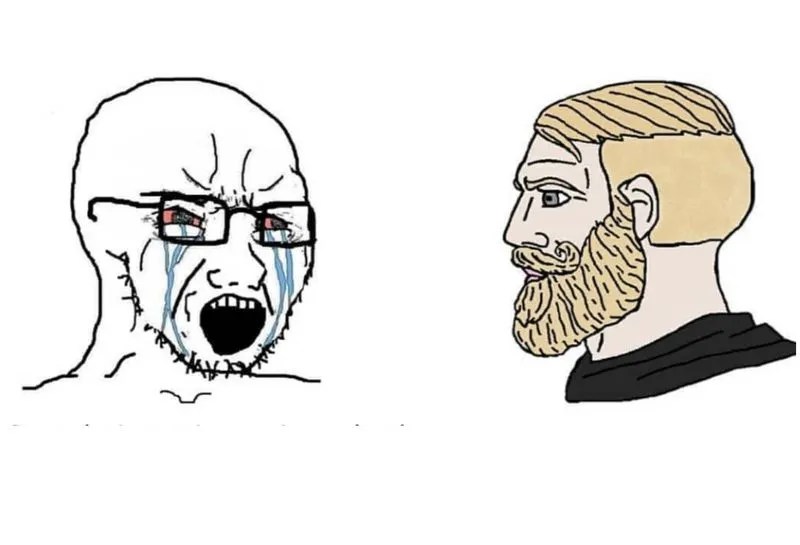
With this growing indifference and apathy among the current happenings of the world, anti-intellectuialism must not thrive with the kind of popularity it enjoys. It is a whole different discussion if a large section of the audience consuming these jokes were well-aware and educated, but then again, an incident like with the Indian vlogger wouldn’t have occured, and the transformation of such a trite stereotype turning into a popular meme wouldn’t have happened in the first place. If you are a fan of dark humour, it is also onto you to expect better from your favorite comedians.
The problem isn’t even the likes of shows like India’s Got Latent, or comedians like Samay Raina, Harsh Gujral etc. the problem solely lies with the regressive audience that consumes it, and touts it as something of immense value – if it doesn’t entertain the audience anymore they will move on to different things.
I have long been a fan of dark humor, but what this current mainstream nature of this sub-genre has become is just plain stupidity. Call me elitist if you want, but it is what it is. It’s embarassing to even claim you enjoy dark humour at this point, considering how it has been associated with regressive ideas and an audience that refuses to think for themselves.
Every one around is you passing some comments or quips in the name of ‘dark humour’, there is no novelty to it anymore. Apathy is the norm, sympathy and empathy makes you look stupid.
It’s not that India is not ready for this humor – India has always been making this humour, just that it’s gotten a cooler, westernized packaging now.
 A notebook.
Leave a comment